
Chainsaw Man – Reze Arc: The Humble Romance and Madness
Chainsaw Man – Reze Arc: The Humble Romance and Madness
Reze’s departure—like her sudden appearance on that rainy day—feels abrupt yet oddly natural at the same time. This is a dreamlike tale, and the recurring fable of the country mouse and the city mouse can be a key to unlock it.
Threaded through the main plot is the Angel Devil and Aki’s subplot, the Angel Devil’s change of heart is a concrete embodiment of the country mouse/city mouse allegory. He first declares himself a country mouse—he’d rather die than work—yet he’s moved when Aki risks shortening his own life to save him. After helping kill Reze, hearing Aki’s simple, sincere “we’re partners,” the Angel Devil stands high on the building and murmurs to the rats below, wondering, “Are you happy in the city?”
If the country mouse drifts along content with what comes, then the city mouse—staking life to pursue some surplus value, that extra “delicious food”—may well stand for the bonds and genuine feelings that grow between people. By the same token, Denji’s question to Makima at the opening—“Do I have a heart?”—further underscores the city mouse’s symbolism of seeking genuine bonds.
Asked to choose between city and country, Denji answers without hesitation: he wants to be a city mouse. Given the horrors of his childhood, he has never lived a life of comfort; a roof over his head and a full belly are his dream and his luxury. Why wouldn’t he wager his already precarious life on such a dream? In contrast, in the end as Makima narrates a tale about killing country mice before winter while killing Reze, she plainly casts Reze as the country mouse: Reze “abandoned” the Chainsaw Devil’s heart and her power, choosing ease for the sake of private feeling.
Beneath the misaligned choices between Denji and Reze, there lies a shared biography: neither of them has gone to school; both hover in that liminal space between youth and adulthood. Denji’s childhood is one long suffocation, while Reze’s is scarred by the Soviet Union’s inhuman experiments. Denji is, without question, thick-skinned; the cascade of tragedies has numbed him but never felled him. Called “like my dead dog” by Reze, roaring that “every woman around me wants to kill me,” he seems pitiable to outsiders yet does not collapse into despair. He is driven by sex and hunger, and yet a flicker of delicate real feeling glows in the seams of those desires. He is filthy and pure at the same time, like the white daisy he offers—slick with spit. The chewed-back flower is admittedly revolting, but he never crushes a single petal. Asking Makima whether he has a heart, letting Reze go by the sea, waiting in a café with flowers in hand—his motives are naive and unadulterated. Beneath the grime of appetite lies a daisy-white essence. For Reze—herself unworldly in her own way—calling Denji “interesting” wasn’t entirely a lie.
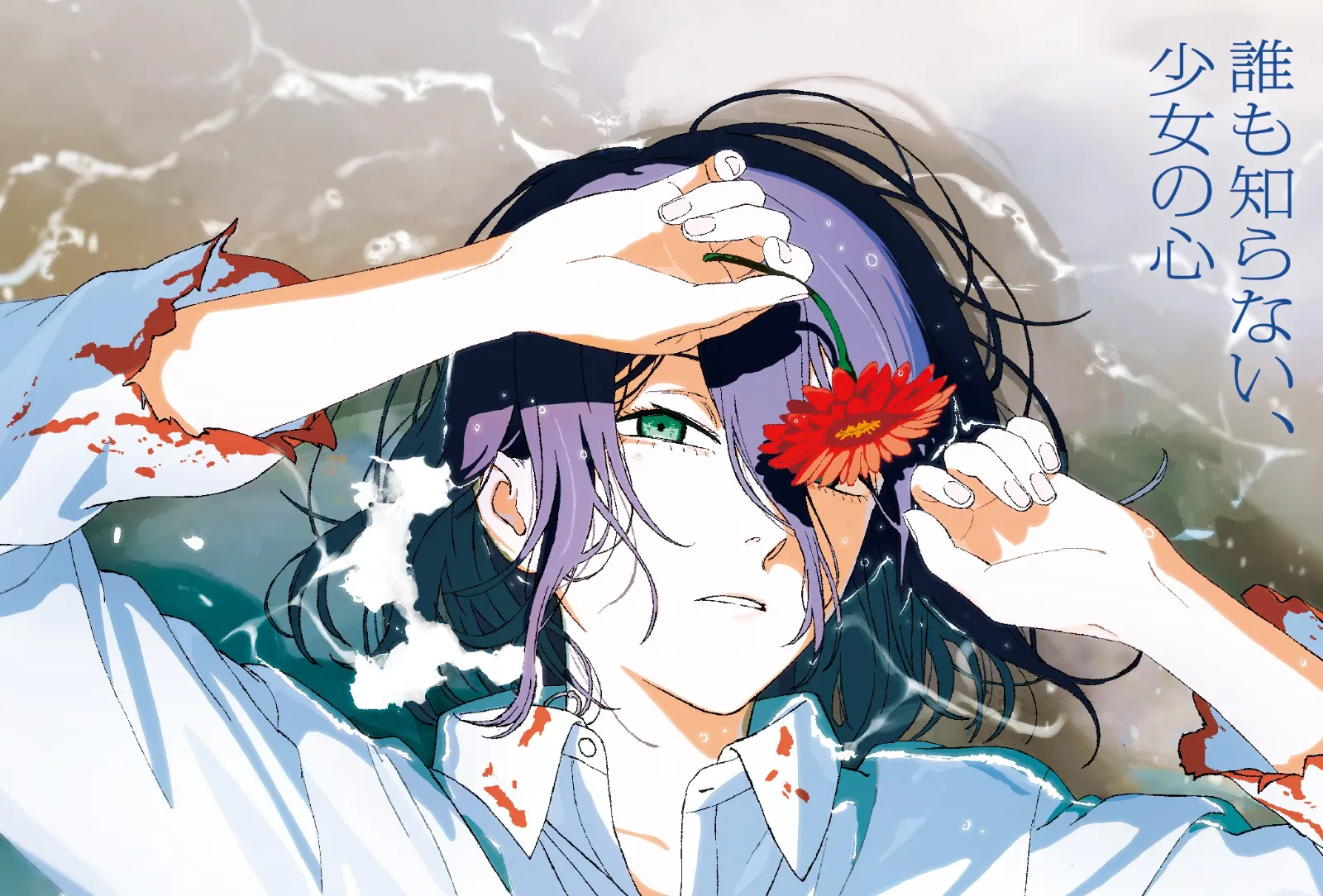
At the end, Reze also holds a daisy, fresh and lovely yet bright red—like her graceful poise and her blood-stained hands. Even if she claims her words were all deceit, she doesn’t kill Denji at their first café meeting, and she still chooses to keep their promise of meeting in that café in the end. Her flower’s red is vivid and tragic. We are given Denji’s full interior monologue; Reze’s heart, by contrast, is left blank. With a past as wretched as Denji’s, Reze is lonelier and slightly more mature. She hides herself in lies, yet she yearns for feeling and for a “heart” all the same. As Denji points out, even if her words were false, she really did teach him to swim—and that is unshakably true. How much of her “let’s run away” and “I love you” was a lie—and how much was real?
Looking back now, the country/city mouse metaphor blurs into dialectic. Makima dismisses Reze as a country mouse, yet Reze does not board the outbound train to the rural city of Sendai. Instead, she stays in the noisy, perilous city for the sake of a promise. Cowardice to Makima, perhaps—but for Reze, the pursuit of honest feeling is also the life-betting gamble. She is a city mouse too: a poor soul who has found the bond that gives the heart its tether and is willing to take risk for it. As the one who posed the question, she never answers it herself. In addition, nor is Denji as straightforward as his declared choice of city mouse. Though entranced by Reze at first, he nonetheless grows attached—country-mouse-like—to the budding routine of Public Safety Devil Hunters and cannot agree to elope. Still, when he defeats Reze, like Reze, Denji becomes a city mouse again for the sake of that heart-tied bond, cocooning himself willingly. He lets her go, knowing it betrays his job.
All of this resolves into the Angel Devil’s last rooftop line to the rats: “Hey, do you like life in the city?” From the outset, perhaps everyone in this story has been slightly mistaken. Whether they choose country or city, they cannot escape the fate of being small and powerless—like mice. Worse, hemmed in by towered skylines, they cannot even choose between country and city; all that can be asked of them is whether they like it, not what kind of mouse they want to be. The squad captain paints Aki a bright future; inside, Aki counts the five years he has left. Ironically, the captain full of tomorrow’s hopes dies in the battle with the Bomb Devil soon after. Reze walks her familiar path with light steps, only to fall in a pool of blood just shy of the alley’s opening; the last thing she sees alive is the back of that man with a bouquet, a few meters away.
We are all, in our way, as sorrowful as mice.